


To better adapt to realistic motions at sea, LR has introduced a major upgrade to its suite of container stowage solutions, designed to help reduce container loss, maximise utilisation, and strengthen operational resilience. The aim is to move stowage thinking from static assurance to continuous risk management, grounded in physics and delivered through practical digital tools.
Container ship operations have never been more complex, as successive generations of ship become ever-larger, routes are increasingly subject to sudden change, and weather systems more volatile.
For today’s operators, managing these risks at sea is paramount. Confidence in stowage must extend beyond compliance at departure and extend throughout the voyage.
A new approach for unpredictable conditions
By acknowledging the limits of current stacking methods, a better understanding of the physics of stack behaviour is possible using new tools. These tools give crews and operators clearer, actionable guidance and greater confidence in their stacks at sea.
Nonlinear roll responses from unpredictable waves and shifting load paths affect container stack dynamics and can push the best models to their limits. Long period swells and unusual encounter angles can quickly trigger a condition where reliable predictions of stack behaviour narrows and safety margins can disappear.
LR’s enhanced suite brings upgraded versions of BoxMax and Roll Design Assessment (RDA) with the latest releases of LashRightUX and the new RollRight digital platform together. Each tool tackles a different part of the problem.

-
BoxMax helps optimise stack configurations
-
LashRightUX assesses securing arrangements
-
RDA and RollRight give insight into roll related vulnerabilities from the design phase through to daytoday operations
Together, these tools create a connected ecosystem that links design intent, loading decisions and operational reality.
Over the past two decades, container ship capacity has more than doubled, with taller stacks, higher lashing bridges and more demanding load paths to consider.
Traditional assumptions underpinning stowage calculations struggle to capture the nonlinear behaviour of modern container stacks. In real condition, containers separate, reengage and interact dynamically with lashings and supporting structures.
LR’s solutions are built on high-fidelity modelling that reflects these realities, improving confidence in both design approval and onboard planning.

Righting rolling
These tools also help to address parametric rolling, which can quickly push vessels beyond their design roll angles. Tools like RDA and RollRight, which use up-to-date information on sea conditions, help operators spot when their vessel may trend towards dangerous conditions. Advance warnings and practical recommendations can mitigate risks, from adjusting speed and altering course to making targeted ballast changes.
These early warning capabilities don’t eliminate uncertainty, but they significantly improve a crew’s ability to avoid high-risk scenarios before they develop.
Rolling is a defining operational challenge for large container ships, particularly those with slender hull forms and high length-to-beam ratios. Certain combinations of wave length, heading and speed can trigger sudden and severe roll responses, even in conditions that may appear manageable. By embedding ship-specific roll behaviour into onboard guidance, LR’s tools support earlier, better informed decision-making at sea.
Continuous improvement
There are areas where industry knowledge remains incomplete. Full-scale validation data, such as in-service lashing stiffness and true dynamic load transfer within stacks, remains scarce. Without it, models cannot capture every real-world nuance.
Ongoing collaboration between class, owners, operators, and terminals is essential to fill in these knowledge gaps and the foundation of the LX Consortium, to focus on open standards and continuous improvement. Improving stowage safety is not a closed problem, but an evolving one that depends on shared learning and better data.
Technical solutions must also be practical. LR’s suite of stowage tools emphasises simplicity and clarity, based on operational reality. For example, LashRightUX gives users an intuitive interface and replaces manual effort with fast, interactive modelling, supporting safer, smarter loading.

Improved containership stowage relies on better data, smarter tools, and a willingness to be honest about uncertainty across the industry. LR’s evolving suite of stowage tools represents a meaningful step in that direction, not because it claims to solve every challenge, but because it is built to help crews and operators make informed decisions when margins for error are thin.
Engineering confidence is no longer about eliminating risk, but understanding that risk better and acting decisively.
Report – The Future of Container Stowage: Design and operational measures for optimum stowage
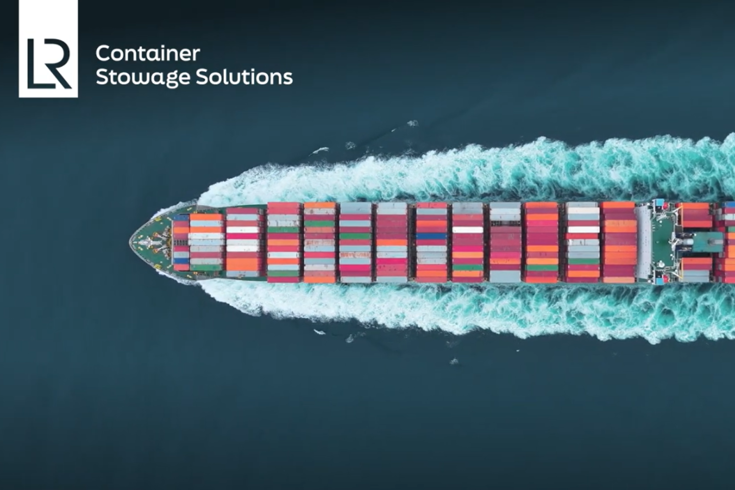
Container Stowage Solutions
