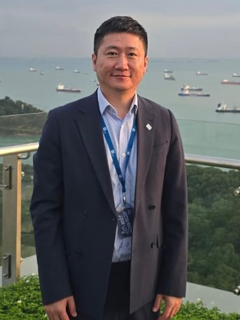
When LR Lead Data Scientist Asger Christian Schliemann Haug presented his latest research findings to IMO delegates, it was a moment that brought years of investigation, lived experience and growing industry concern into a single, focused discussion.
For Haug, SDC 12 marked a significant milestone. “When I took on the Alarm Management project back in 2023, we believed it had the potential to significantly improve maritime safety,” he says. “But we also knew that nothing would change unless everyone was willing to engage with it.”
Haug’s research took a critical approach, first investigating if there was a challenge (Volume 1), then potential improvements for existing ships (Volume 2) and also for new ships (upcoming Volume 3).
That sense of shared responsibility has been central to the work from the beginning. And at SDC 12 there was a clear sense that the industry is starting to align around the issue. “IMO SDC 12 has been a turning point,” Haug reflects, “showing the resolve of many member states and NGOs in leaning into this.” The issue gained new visibility and urgency at the IMO level after being formally raised, in part, by the Norwegian Maritime Authority following recommendations from the Viking Sky investigation.
From analysis to international attention
The work traces back to recommendations for the management of cargo alarm systems issued by the Society of International Gas Tankers and Terminal Operators (SIGTTO), which flagged a clear disparity between maritime practices and the more mature alarm management frameworks used in shore-based industries.
“Looking into this early on, it was clear that there was quite a lot to learn from our neighbouring industries,” he explains. “That’s when it became clear this wasn’t just a small improvement exercise to see whether our rules could align better. It was something more fundamental.”
To understand the scale of the problem, Haug and his team collected data from vessels, spoke to seafarers and analysed more than 40 million events from the alarm logs on ships. What emerged was a consistent picture across ship types and operating profiles. Alarm systems often produce so many alarms, it exceeds what a human operator can reasonably process. In those moments, discriminating what is important becomes difficult, if not impossible. Trust in the system reduces. Decision‑making suffers.
The results confirmed what many at sea had long reported: alarm systems frequently overwhelm rather than assist.
“If you hear a chief engineer say they get too many alarms to even count, and then you see 4,000 alarms in ten minutes in the data, you know they’re not exaggerating,” Haug notes. “It was important to put that human experience next to the objective evidence.”
A shift in how alarms are understood
This integration of human and technical perspectives is central to the work. Haug’s expertise, through his degrees in marine engineering and data science alongside his experience working at sea, allowed him to analyse event logs and conduct onboard studies, using his technical and analytical skills for deeper investigations.
In Haug’s view, maritime alarm management has long been misunderstood to be merely about presentation of alarms.
“At its core, it is about managing the abnormal situations behind the alarms,” he explains. “Although we describe these situations as ‘abnormal’, they are still a foreseeable part of a ship’s design basis—otherwise, an alarm would not have been installed in the first place. And that’s a different way to think about it.”
“An alarm is essentially a request for a human response. It’s a system's cry for help” he explains. “If the alarm response isn’t feasible, because there are too many alarms, or they’re unclear, or they arrive too late, then the system isn’t supporting safety, regardless of how it looks on paper and what colour it [the alarm] has.”
Addressing this issue is urgent, supported by industry-wide safety data. Maritime incident rates have remained broadly static over the past decade, with a significant proportion attributed to human error. For Haug, that statistic points to a design issue rather than a people issue.
“We need to start treating human factors like any other engineering discipline,” he says. “Because there are just as many design constraints around a human, probably more.” Haug emphasises the importance of better understanding the engineering crew and how they use alarms in their daily work. “We currently emphasise getting out onboard, to observe how the crew deals with alarms in real life.”
Recently, Haug visited the Saga’s Spirit of Discovery to explore how the trustworthiness of alarm systems can be improved. “We use eye tracking a lot. It is a powerful way to understand how people allocate their cognitive attention,” he explains. “It gives us an objective basis of learning whether engineers actually found a particular alarm useful or not. The simplest thing in the world is to sit with the watchkeeper and ask them. But to do so after their watch so you don’t disturb them.”
Why the timing matters
The presentation at IMO SDC 12 gave member states and NGOs a robust, evidence-based foundation for discussion. It helped move the discussion away from isolated incidents and towards a broader understanding of how alarm systems function in real operations.
“Our role isn’t to tell the industry what to do,” Haug says. “It’s to give an informed basis for the discussion on the development of a new performance standard called Engine Control Room Alert Management (ECRAM)."
The IMO’s response suggests that approach is working. Several member states have already referenced LR’s research in their IMO submissions, and a correspondence group is now being established to take the work forward. “I am confident that Anne Norderud-Poulsen from the Danish Maritime Authority will be an excellent coordinator for the correspondence group,” says Haug.
Another aspect is the adoption of novelalternative marine fuels. Amelia Hipwell from LR’s Maritime Decarbonisation Hub (MDH) joined the visit to observe first-hand (Figure 6). Hipwell says, "The alarms challenge will become even more critical as new fuels are adopted, with increased system complexity potentially leading to a further increase in alarm volumes, fuel characteristics resulting in greater reliance on detection technologies and often a reduced time available for corrective action.
“Without intervention, current weaknesses in maritime alarm system design will be amplified, placing excessive and unrealistic demands on the crew. Addressing these challenges is fundamental to ensuring a safe transition to new fuels.”
Intent to impact
For Haug, the importance of steady, collaborative leadership is fundamental to the success of the work. “If you just push solutions onto people, it doesn’t work,” he says. “It has to be an organic process where everyone is involved.”
This includes not only regulators and designers, but also manufacturers and seafarers, whose insights are critical to ensuring practical applicability. “In our view, the performance standard for ECRAM should be developed from the front line of ship operations, because that’s the context where it needs to work,” Haug says.
This human-centred perspective is deeply personal for Haug. Having worked at sea, and with close family members still in seafaring roles, he remains closely connected to the realities faced by crews. “Everybody out there is someone’s family,” he says. “As safety professionals, we have a duty of care to make sure these systems actually help them do their job safely.”
Looking ahead, the next phase of the work will focus on practical guidance for designing alarms that are genuinely useful from the outset. That means making sure alarms are actionable, timely and reasonable, while enabling front line safety professionals such as surveyors to objectively evaluate these qualities during the newbuild process, a time when changes can still be made at minimum cost rather than after a ship is built.
“There is currently a strong focus on alarm design, or rationalisation. At first, many think it is just a colouring exercise, or simply prioritisation, but once you begin, you quickly realise its real purpose is to ensure that the crew has a realistic chance to respond to the abnormal situation behind the alarm itself, thereby preventing a consequence of concern.”
Research at the front-line
For his research on Volume 3, Haug teamed up with the engineering crew onboard Spirit of Discovery to investigate alarm-nature in detail. They worked on rationalising the alarms that everybody had complained about since the vessel entered service, and collected important data on how long it takes the crew to perform corrective actions in response to real alarms (Figure 4).
Haug talks about the corrective actions taken over the week onboard, and solutions are sometimes straightforward – even a single mouse click. At other times, it’s a time-consuming process in which several safety actions must be done in a specific sequence, and at various locations on the ship.
Haug emphasises, “The manual valves located under floor plates - it can take quite some time to find them, even for experienced engineers. On ships like these, you simply can’t know everything.”
Even for existing ships, rationalisation activities onboard is engineered welfare for the crew.
Haug explains, “The crew had a great teambuilding experience working through these alarms. Especially since the owner ensured that two additional and very experienced crew members were on it full time,” adding that, “We refined the process out here together with the crew, the ship’s superintendent, and owner, all of whom were onboard during the study.” Haug says it is important everyone feels that they are in the same boat.
“If the process is too onerous, it is unlikely to be used,” he says. “It is about finding the right balance. One that enables continuous improvement in a controlled and documented manner.”
What SDC 12 has done is bring that reality into sharper focus
For Haug, that shift is both encouraging and necessary. “This is about recognising that people are part of the system,” Haug reflects. “If we design alarm systems that genuinely support the crew, especially when conditions are at their most demanding, we can make a real difference to safety at sea.”
“Its field studies like this that can really help policy makers at the IMO make informed decisions,” he concludes.