


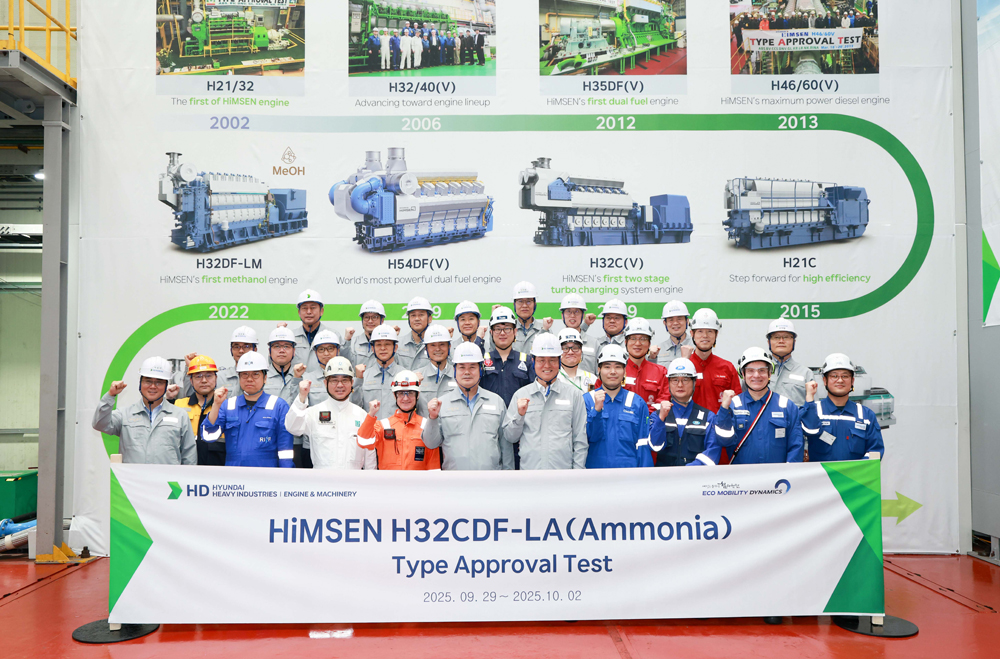
When HD Hyundai Heavy Industries – Engine Machinery Division (HHI-EMD) and LR gathered in Korea in September this year for the type approval testing of a new ammonia-fuelled marine engine, it represented more than another step in alternative-fuel development. It marked a decisive moment in the industry’s advance toward large-scale, practical and safe ammonia propulsion. For the first time, a commercially relevant, multi-megawatt ammonia engine intended for real-world maritime operations successfully completed a classification type approval programme.
The engine at the centre of this achievement, the H32CDF-LA, is HHI-EMD’s latest addition to its low-carbon HiMSEN engine portfolio. HHI-EMD’s Head of Engine Development, Seonghun Lee said “The H32CDF-LA is an ammonia dual-fuel engine based on the proven H32C diesel platform and equipped with the world’s first high-pressure direct-injection ammonia technology introduced in 2024.”
The increase in power output marks a significant development. Earlier HiMSEN ammonia research focused on the H22CDF-LA model, which produced 1.4–2.2MW. In contrast, the latest engine delivers a maximum output of 5.4MW, more than twice that capacity.
During the type approval campaign, the engine was operated at nearly 4,000kW on the testbed, which LR’s surveyors highlighted as a genuine first for ammonia.
Innovation from within
At the heart of the H32CDF-LA’s performance lies one of its most important innovations: the electro-Hydraulic Boosting Unit (e-HBU). Lee explains, “As a high-pressure supply system fully integrated within the engine, the e-HBU delivers ammonia to the common-rail injection system at precisely controlled pressures, ensuring stable combustion despite the fuel’s challenging properties.”
The engine’s medium-speed operation at 720 rpm makes it suitable not only for main propulsion but also for auxiliary generation, a versatility that broadens its appeal across vessel classes. Its dual-fuel design preserves the ability to operate on conventional marine fuels, including HFO, ensuring operational resilience during the early years of ammonia bunkering infrastructure development.


A demanding approval campaign
If ammonia is to gain acceptance at scale, it must be demonstrably safe to handle, both on testbeds and ultimately at sea. HHI-EMD and LR approached this project with that priority at the centre of their work.
“As a result, the engine successfully demonstrated compliance with LR’s safety requirements for handling ammonia fuel,” Lee notes. That conclusion followed an extensive programme of safety assessments, including preparatory work by LR’s safety specialists and the HHI-EMD team.
Due to the significance of this particular Type Approval Test, LR Global Gas Technology Director, Jose Navarro, took an active role in the preparation and attendance to the test in collaboration with our Local surveyors in Ulsan represented by Ki Soo Yoon and LR Busan Technical Support Office specialists represented by Jong Yong Ha.
The type approval process stretched over several days of full-load testing, fuel changeover trials and detailed safety demonstrations. This was, in one sense, a routine activity for LR: engine type approval tests are conducted monthly across a variety of manufacturers and fuels. Yet the ammonia fuel element changed everything. As LR’s team noted, this was a novel test programme not because ammonia had never been burned in an engine before, but because it had never been burned at 3.6–5.4MW scale, on an engine capable of commercial application.
A substance as toxic and reactive as ammonia demands absolute precision in fuel containment and handling. LR’s inspection and safety specialists, including Safety Manager Yu-Mi Hwang, visited the facility in advance of the tests to assess ammonia supply systems, verify emergency preparedness and review personal protective equipment. The site was equipped with emergency showers, eye-wash stations, chemical suits and appropriate respiratory protection, while the team traced every potential leakage point throughout the fuel supply chain.
Navarro said “Across three days of continuous testing, we observed no detectable ammonia concentrations, not even inside the annular spaces of the fuel piping systems. This was an outstanding outcome given ammonia’s strong odour threshold and the sensitivity of detection equipment in use. The fuel supply system installed at the HHI-EMD testbed performed robustly, maintaining complete containment even during dynamic scenarios such as controlled fuel changeovers.”
Lessons from the testbed
The test campaign underscored the critical need for meticulous attention to detail. Every gasket, every joint, every monitoring point demanded scrutiny far beyond that applied to conventional fuels. According to Navarro, “the complexity of material compatibility assessments alone represented a significant undertaking, given ammonia’s corrosive potential and its interaction with elastomers and certain metals. This heightened level of engineering consideration, however, is precisely what enabled the engine to run without incident and without measurable emissions during testing.”
Equally important was the collaborative dynamic between manufacturer, classification society and safety personnel. Each party contributed specialist knowledge, challenging assumptions and reinforcing a culture of shared responsibility. “This type of collaboration is essential if the wider market is to take confidence from pioneering projects such as this. Demonstrating a safe, successful operation sets an example for other engine builders contemplating similar developments,” says Navarro.
Ammonia’s role in a multi-fuel future
The maritime sector is unlikely to settle on a single dominant fuel in the coming decades. Fuel choice will vary by ship type, trade route and regional availability. In this multi-fuel future, ammonia stands out as one of the key scalable options capable of meaningfully reducing greenhouse gas emissions.
However, challenges remain according to Navarro. “Regulatory adoption and standardisation must continue to evolve. Crew training and operator confidence will require significant investment and the development of dedicated training programmes adapted from ammonia cargo handling expertise,” he says. “Above all, the creation of a green ammonia supply and bunkering network is essential, mirroring the trajectory seen in LNG over the past decade.”
Yet amid these challenges, the successful type approval of the H32CDF-LA demonstrates tangible progress. It provides proof that a safe, reliable ammonia engine is achievable.

A milestone with momentum
For HHI-EMD and LR, the significance of this achievement reaches beyond a single engine model. It signals that the technologies, safety cultures and collaborative frameworks required for ammonia propulsion are not distant aspirations, they are already being constructed, tested and validated. As Lee concludes, “HD Hyundai Heavy Industries will continue to expand its ammonia DF engine portfolio in cooperation with LR, leading the global maritime sector’s decarbonisation efforts and driving the transition toward a more sustainable marine environment.”
