


As the maritime sector intensifies its search for viable zero-carbon fuels, ammonia has emerged as one of the leading contenders. Its global availability, established transport infrastructure and favourable energy density place it among the few alternatives capable of supporting large-scale ocean transport. Yet one barrier has persisted: the lack of a practical regulatory pathway for its safe use as fuel on gas carriers.
Now, a collaboration between LR, EXMAR and the Belgian Federal Public Service for Mobility and Transport (FPS Mobility) has produced the first Interim Guidelines enabling gas carriers certified under the International Code for the Construction and Equipment of Ships Carrying Liquefied Gases in Bulk (IGC Code) to consume their own ammonia cargo as fuel. It is a signal that the industry is shifting from ambition to implementation, supported by practical frameworks that allow innovation to progress safely and confidently.
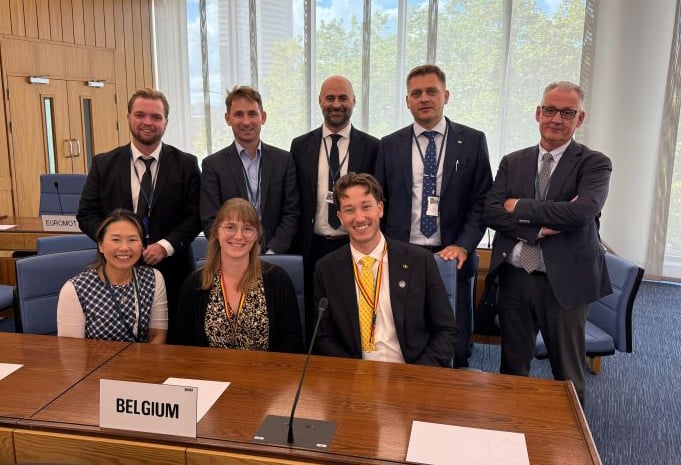
Back row (L-R) Jordy Delvaeye, Project Manager Technical, EXMAR; Liam Blackmore, Principal Specialist - Decarbonisation, LR; Pieter Blommaart, Strategic Business Partner, LR; Andriy Nedenko, Technical Superintendent, EXMAR; Peter Van de Graaf, Strategic Business Partner, LR.
Front row (L-R) Nikki Ng, Technology Specialist Process Safety, LR; Nathalie Deleuze, Maritime Expert for Alternative Fuels, FPS Mobility; Diederik Wéreau, Alternate Permanent Representative of Belgium to the IMO
Unlocking a long-awaited regulatory shift
Historically, the IGC Code prohibited the use of ammonia cargo as fuel, reflecting longstanding safety concerns around toxicity, leakage and emergency handling. For a fuel widely recognised for its decarbonisation potential, this created an untenable mismatch between regulatory restriction and industry ambition.
Recognising the need for change, FPS Mobility, working closely with LR and EXMAR, initiated efforts more than two years ago to amend the Code. Their work resulted in the removal of the restrictive provision, opening the door for the development of technical and operational guidance that would allow ammonia fuel systems to be introduced without compromising safety.
The partners then drafted the initial version of the Interim Guidelines, submitting it to the IMO Correspondence Group responsible for their evaluation. What followed was a detailed, multi-national evaluating development process, working closely with Member States to ensure consensus around engineering requirements, operational safeguards and risk-mitigation measures.
Finalised at the IMO’s Sub-Committee on the Carriage of Cargoes and Containers (CCC 11), the Guidelines are expected to receive formal approval at MSC 111 in May 2026. Their adoption will provide shipowners with the first coherent, recognised regulatory route for developing ammonia-fuelled gas carriers — a long-missing enabler for investment and implementation.

What the Guidelines enable
The strength of the new framework lies in its balance between safety and flexibility. While maintaining the IGC Code’s core safety philosophy, the Interim Guidelines give designers and operators clearer expectations on system integration, hazardous zone management, ventilation and monitoring, fuel containment, and emergency shutdown arrangements.
For the maritime community, this clarity is essential. It allows early-stage concepts to mature into class-approved designs and gives regulators confidence that risk mitigation can be applied consistently across the fleet. As ammonia is both toxic and corrosive, the Guidelines’ emphasis on containment integrity, leak detection and crew protection will be particularly welcomed by operators planning pilot projects or newbuild programmes.

LR’s technical depth shapes the pathway
LR’s involvement in ammonia-fuel technology extends beyond advisory work. Its experts have supported ammonia-fuel feasibility studies, system concept designs and early demonstration projects, giving the organisation a deep understanding of the engineering and safety challenges.
Claudene Sharp-Patel, LR’s Global Technical Director, says “this collaboration shows what’s possible when industry leaders, regulators and technical experts come together to enable change. LR has been involved in ammonia-as-fuel projects from their earliest stages through to realisation. The deep knowledge and expertise we’ve developed directly benefit our clients as they look to decarbonise their fleets. Being part of this pioneering work reinforces LR’s position as a trusted advisor and innovation leader in the maritime energy transition.”
EXMAR’s innovation rooted in experience
For EXMAR, the Belgium-based shipowner and gas carrier specialist, the journey toward ammonia fuel began in 2021, when it received Approval in Principle from LR for an ammonia-fuelled mid-size gas carrier. That early move reflects the company’s long-standing strategic priority of using their own cargo as fuel.
After having led the adoption of LPG propulsion technology, the company views ammonia as the next step forward. Its potential to reduce direct CO₂ emissions by up to 90 per cent compared with conventional fuels makes it an attractive pathway for future fleet development.
Kristof Coppé, Director of Fleet Operations and Technical Business Development, explains “our close collaboration with Lloyd’s Register and FPS Mobility in Belgium has been instrumental throughout this process. Their support, particularly on the regulatory front, has been a cornerstone in advancing this project toward success.”


Belgium’s role as an energy-transition facilitator
Belgium’s government has positioned itself as an active enabler of maritime decarbonisation, linking policy oversight with technical engagement. FPS Mobility’s involvement in the ammonia initiative reflects its commitment to accelerating low-carbon fuel adoption through early regulatory support.
Nathalie Deleuze, Maritime Expert for Alternative Fuels at FPS Mobility, says “decarbonisation is a key priority for Belgium. At the FPS Mobility and Transport, we’re committed to facilitating the shift toward alternative fuels. To make this happen, we combined our expertise in IMO processes with the technical know-how of pioneering Belgian shipowners and Lloyd’s Register. Together, we’re charting the course toward a cleaner future.”
Unlocking future-ready vessel design
With the Interim Guidelines now finalised and awaiting formal approval, shipowners, fuel developers and technology providers can begin planning with far greater certainty. The Guidelines not only remove a long-standing regulatory obstacle but also provide clarity on safety expectations, system design and operational considerations.
This regulatory certainty is essential for investment, and it marks a crucial milestone in the wider maritime transition to zero-carbon fuels. As the industry seeks scalable alternatives to fossil fuels, ammonia is increasingly viewed as one of the few options capable of supporting shipping’s energy demands over the long term.
The successful development of the Interim Guidelines demonstrates that cross-industry cooperation, built on deep technical expertise and shared ambition, can deliver the regulatory frameworks needed for transformative change.
