


The global shipping industry faces a problem. Just as the maritime industry needs to attract a new generation of digital-native seafarers to operate the high-tech and digitally connected ships of the future, many existing seafarers are heading for home.
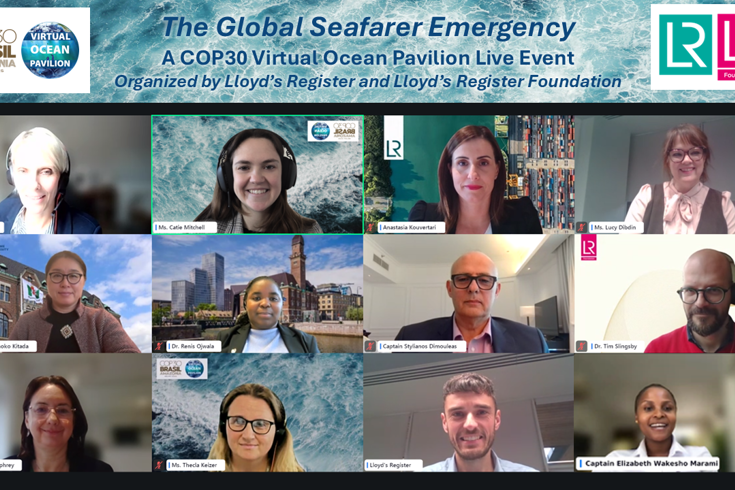
Lloyd’s Register and Lloyd’s Register Foundation hosted a webinar in conjunction with the COP30 Virtual Ocean Pavilion in November to discuss the critical shortage of skilled seafarers, which threatens the future of the maritime sector, and the transport of more than 80% of the world’s trade.
Chaired by LR’s Chief Marketing Officer Philippa Charlton, the webinar featured industry experts and seagoing staff. Charlton stressed global shipping’s vital role in supporting targets set out in the Paris Agreement by adopting new technologies and focusing on the strategic development of new fuels.
Seafarer supply and demand: a crisis?
New marine fuels and their related technologies, essential for global shipping to reduce its emissions in line with IMO goals, have already arrived or will soon become available.
All require new handling skills and expertise for safe operations and to reduce health hazards and damage to marine assets and surrounding infrastructure. But legacy maritime training programmes have not kept up, and may neither adequately upskill existing seafarers, nor train a new generation of recruits.
Worse, fewer people now opt for a career at sea, creating a personnel problem which is becoming increasingly urgent. Without a well-skilled, safe and happy workforce, the smooth passage of world trade faces disruption. Discussions must urgently turn into action, Charlton said.


Daunting numbers
Lloyd's Register Foundation Chief Executive Ruth Boumphrey set out the scale of the ocean worker crisis: some 1.9 million seafarers are employed at sea according to UNCTAD in January 2025.
Seafaring is one of the most dangerous jobs, she said, there are between 50-100 fatalities per 100,000 workers. Meanwhile, one in three seafarers has been harmed by severe weather, with climate change potentially exacerbating this.
Half of seafarers come from Asia Pacific, a third from Europe and 4% from Africa. A tiny number are women – just 1.3%. 70% have reported fatigue, Boumphrey said, with seafarers working long shifts round the clock, seven days a week, often with little or no shore leave.
The industry needs a new generation of ocean workers. But will they be attracted by what they hear from those at sea today?
Training to fill the skills gap
The world’s oceans drive global weather systems and will be affected by climate change, which shows the vital need to decarbonise. Yet, a recent survey from HELMEPA-led METAVASEA shows 64% of seafarers in the Eastern Mediterranean received no decarbonisation training in the last two years. Of those that had, 27% said that the training had been inadequate, and 26% admitted unfamiliarity with new fuels.
Without robust training programmes for seafarers and delivering decarbonisation modules to a new generation of ocean workers, seaborne trade risks disruption.
LR CEO Nick Brown said it is urgent to safeguard shipping’s greatest asset – its people. “When young people consider their career options, they have a different set of criteria to those who entered the workforce 30, or even ten years ago. Fewer young people are going to sea and numbers are declining,” he said.
Filipino Chief Engineer Mokoi revealed the challenges relating to new fuels and said the Maritime Just Transition is essential to equip seafarers with the skills to manage new fuels effectively.
“Their training, education and support must evolve in parallel with technology,” he said. “A low-carbon ship is only as safe as the crew that runs it… Let’s empower seafarers to lead this transition safely and sustainably.”
Capt. Samarth Sinha echoed Mokoi’s comments, emphasising the critical importance of new fuels to decarbonise shipping. He said every crew member needs new skills, sharper awareness and a shift of mindset towards decarbonisation.
“Very soon we will see more ships running on alternative fuels… but when we are bunkering fuels like hydrogen, ammonia or methanol, the crew needs specific training,” he said. “They need to follow specific checks before, during and after bunkering.”
A junior officer, Ivan Guzman also from the Philippines, enthusiastically called on shipowners to help colleagues at sea adapt to new fuels. “With every innovation,” he said, “there is one critical factor… the people on board.
“The one move that shipowners can make is to invest in hands-on training right now – not just e-learning or classroom sessions – but on-board familiarisation and real-world simulations that connect theory to practice… A well-trained crew can operate safely, efficiently and sustainably in this new era of shipping.”
He said seafarers should be incentivised to actively participate in making decarbonisation work onboard.
Survival mode
Capt. Elizabeth Marami is Kenya’s first female master mariner and a senior marine pilot at the port of Mombasa. She spent significant periods of time at sea, including as First Officer on a large Celebrity Cruises ship. She says it is no exaggeration to describe the accelerating skills drain as an emergency.
“The workforce is shrinking, commercial pressures are increasing, there’s minimum shore leave, and most seafarers are working purely in survival mode,” she said, adding that seafarers are increasingly isolated with many suffering from depression.
Seafarer training is based on the International Convention on Standards of Training, Certification and Watchkeeping for Seafarers (STCW), running in tandem with periods at sea. This approach creates a bottleneck, however, with examples in Africa.
Despite the labour shortage, Africans face particular challenges in finding employers willing to take them on for sea time. While simulator training and virtual reality learning are important, sea time is essential. Marami said females face similar or greater obstacles.
Professor Momako Kitada, a former seafarer and Head of Maritime Education & Training at the World Maritime University (WMU), said: “It is very sad to see the welfare statistics and there is little sign of any improvement. We are in the 21st century but working conditions at sea are far behind a decent position ashore. There is harassment and bullying… seafarers must understand their rights.”
She referred to regulations including the Maritime Labour Convention which outlines the rights of seafarers and acceptable working conditions, and the International Labour Organization’s Convention No. 90 which related to young people working at night, but added that “many managers ride roughshod over these when under pressure”.
Dr Renis Ojwala, an ocean scientist and gender equality expert also at the WMU, stressed the need for strategies to assess the skills shortage more accurately, in particular to adopt practical frameworks for taking students through the digital and decarbonisation transition.


Welfare and wellbeing
Thankfully, there are exceptions. Capt. Stylianos Dimouleas, a master mariner and CEO of Almi Tankers, believes in a progressive approach to seafarer welfare. Seafarers must contend with many outside challenges including political tensions and regional wars, he said. It is therefore essential that welfare and wellbeing are embedded in management systems.
“Our people know that this is our day-to-day strategy. Digital connectivity is a right, not a benefit,” he insisted. “And we train our senior people in leadership and management so that these skills can be cascaded. 95% of our seafarers say that they feel secure and this is beneficial for them and their families.”
Happy workers with job security are more efficient, diligent and productive, and less likely to cut corners or take shortcuts.
Dr Tim Slingsby, Director of Skills and Education at Lloyd’s Register Foundation stressed the importance of connecting shipping’s various organisations that are in the ‘maritime system’ which, he said, is not operating it should. Shipping bodies must communicate and interact, he said, citing the good work of maritime bodies like IMO, ICS, ITF and ILO. “But there are many others that also appear to work in their own bubbles,” he said.
Anastasia Kouvertari, Senior Lead – Human Competency at the LR Decarbonisation Hub specialises in Human Competency said the speed of maritime change is a concern. Taking ammonia as an example, Kouvertari set out a range of potential hazards and a series of new systems needed for effective safe handling as a matter of urgency. “The are not optional,” she said, “they are a baseline for safe operations.”
Shipping has much to offer. Decarbonisation is an opportunity for organisations to work more closely with one another and take proactive measures to meet the looming gaps both in headcount and training. Investments today will pay off tomorrow and secure the long-term future of the industry.
Watch webinar
