


The UK’s submarine fleet is the key component of the national deterrent, and that deterrent begins its life at Barrow-in-Furness where the submarine fleet is built. The town has been in flux over decades as the funding for new boats has risen and fallen as a national priority.
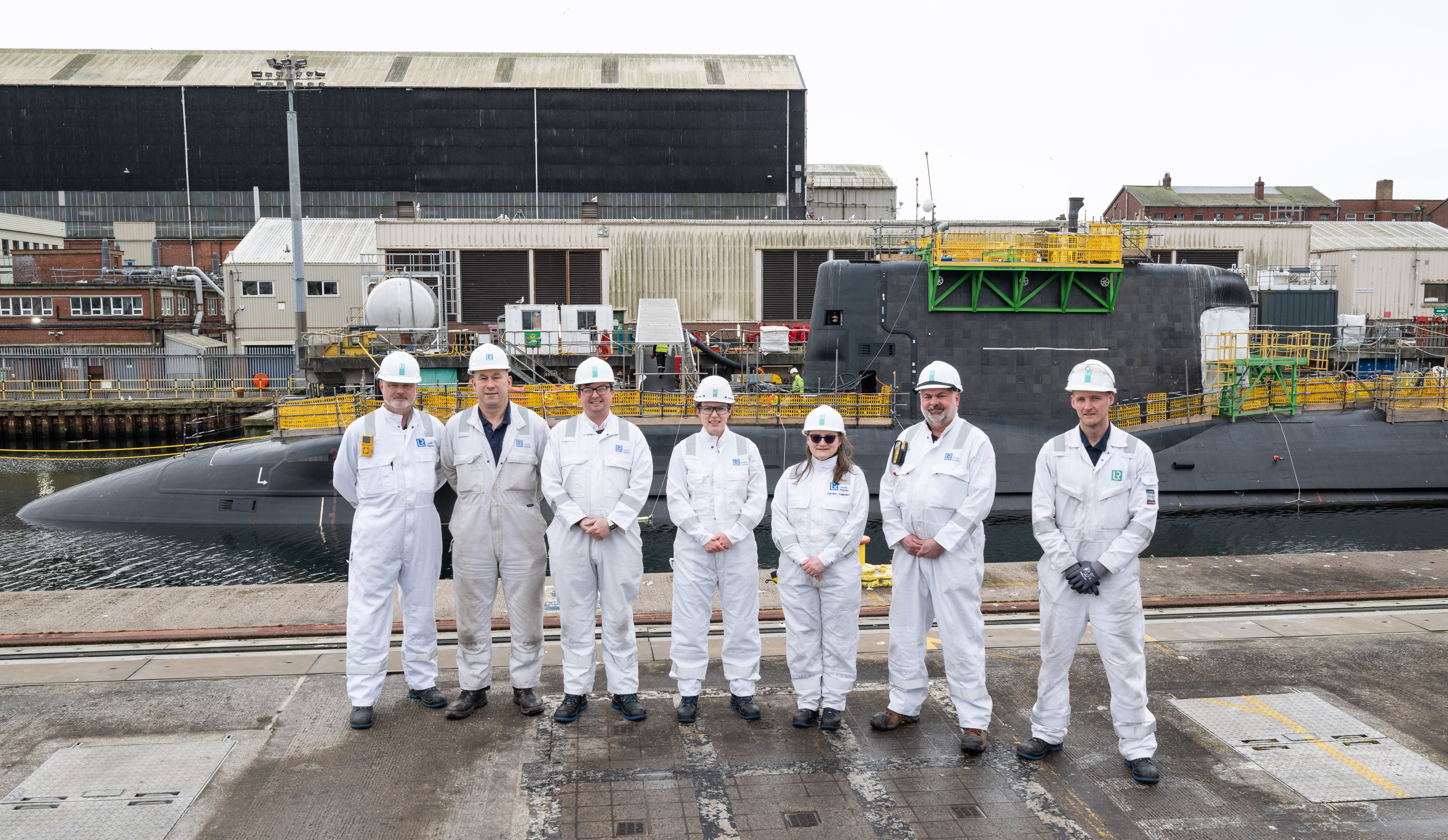
Today, not only is the next generation of submarines under construction for the Ministry of Defence (MoD), but contractor, BAE Systems recently won a contract to supply the Australian navy. Barrow will be busy.
Through thick and thin
By the turn of the millennium, Barrow’s historic shipyard was in a something of a downturn following the completion of the Vanguard-class programme in the late 1980s. Many of the most experienced hands opted to retire and the work pivoted to surface-ship work while submarine work was on hiatus.
LR’s involvement began with classing amphibious ships HMS Albion and HMS Bulwark, both launching in 2001, so the surveyors already knew the yard. As Lead Surveyor Darren Jessett recalls, the pivot came with the commissioning of the early Astute-class submarines. LR was initially invited to assess submarine build processes with two surveyors to support BAE’s product-verification.
“It was a period when a lot of experience had been lost,” says Jessett. “By the time Astute was underway, many of the old hands had retired, and the industry was rebuilding its knowledge base.
“LR became part of the glue that helped bridge that gap,” he says.


Growing with the Programme
From there, LR’s presence in Barrow has expanded steadily. Today, seven surveyors work onsite, supported by three apprentices and additional LR staff working on equipment and component inspections.
According to LR’s Supply Chain Assurance Specialist Carolyn Valentine, an LR surveyor with 34 years' experience, who joined the submarine team in 2012 during her degree placement, LR helps to bring much-needed perspective to the huge ongoing projects.
“BAE’s operations are naturally divided across different facilities, assembly halls, the central yard, Devonshire Dock Hall. Our team moves across all of them. We’re one of the only groups with a full picture of the whole build,” she explains.
This interdisciplinary overview has been invaluable because LR can bring lessons from one part of the programme to another, helping to reduce duplication and improve consistency.
“It’s a quiet but crucial role. We’re able to step back and see the wider process,” says Jessett. “We help to achieve a consistent standard across the yard.”
Rejuvenation
Decisions made more than 20 years ago to renew the submarine fleet have paid off for Barrow, and the town’s status has flourished. Other nations now look to Barrow to support their own naval programmes which is on the cusp of extending into the medium to long term.
While the Astute class nears completion with one final boat to launch, planning for the Dreadnought class continues with Boat 4 entering build this year. On top, the SSN-AUKUS collaborative programme with Australia and the United States is at the design and procurement stage to build up to a dozen vessels in Barrow.
As the programme as grown so has LR’s role. To preserve the continuity of knowledge when some of LR’s surveyors approach retirement – including Jessett and Valentine – three apprentices have started, to stave off a notoriously difficult recruitment process.
“The graduates coming through today often want to move quickly into management roles,” Valentine says. “But submarine surveying is hands-on. You need people who are happy to get out on the boat every day.”
Submarines are not classed in the traditional sense, which means there is some flexibility for the apprentices, who will reach full surveying responsibility earlier than would be possible on commercial ships.
The apprentices study towards HNCs, spending three days a week in the yard. They shadow surveyors, learn practical engineering first-hand and can progress to part-time degrees later, which will qualify them to survey for Class.
Once the Dreadnought boats complete and the next generation of boats begin assembly, these apprentices will be ready to step into experienced roles, giving LR, the Ministry of Defence (MoD) and BAE the continuity they need.


How to Class what cannot be Classed
Part of LR’s original role was to write Class rules for submarines, and help maintain quality and consistency in production.
LR’s Global Director, Submarine Business, Matthew Palmer was originally hired in 2012 to write submarine rules equivalent to those used for ships.
However, this idea ran into a fundamental problem: navies guard their secrets. Rules for submarines was not going to happen so LR changed approach, developing a goal-based process, the Submarine Assurance Framework, published in 2021.
The Framework is designed to verify the safety and integrity of naval submarines throughout their lifecycle. It focuses on confirming submarine design, construction, and material state comply with project specifications, rules, codes, and recognised safety standards.
LR’s evolving role
What began as a support role has expanded into a cradle-to-grave presence.
As Palmer explains, in addition to the build team in Barrow, LR also has a permanent presence at HMNB Clyde at Faslane, witnessing in-service work on behalf of the MoD. Unlike the build contract, where LR works for BAE Systems, the in-service work is directly for the MoD.
This role gives each vessel continuity of oversight with LR between build and operation and allows LR to pass on Learning from Experience (LFE) between the two sites. While BAE builds the submarines, Babcock maintains them in service and the two do sometimes encounter difficulties when sharing information. “LR almost becomes a conduit,” Palmer says. “We help close the loop between Barrow and Faslane, which the MoD has really welcomed.”
And the links go deeper. The team also supports the UK’s Submarine Dismantling Project. While surface ships undergo an Inventory of Hazardous Materials (IHM) process, submarines have traditionally been exempt. But this is changing – the MoD wants to benchmark itself against commercial good practice, and LR helps to manage that, starting with the dismantling and recycling of HMS Swiftsure.

A steady hand
Two decades after LR set-up shop in Barrow to help with construction, the team forms part of multidisciplinary group with national and international reach, supporting build, operation and dismantling, while contributing to global naval standards and mentoring the next generation.
Barrow will continue to expand. The UK’s submarine pipeline stretches long into the future, and consequently, LR’s submarine expertise is as vital as ever.