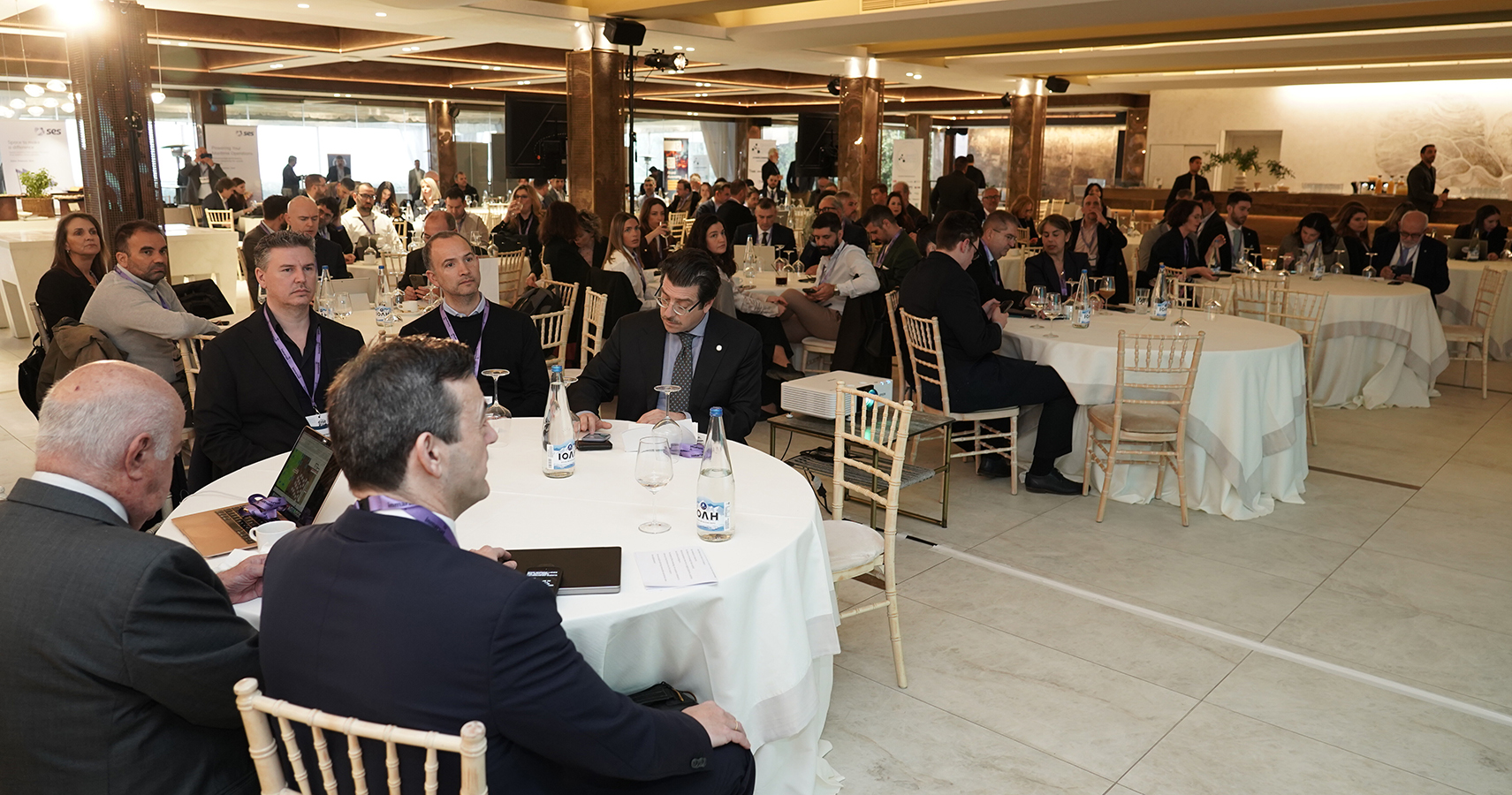
Increasing digitalisation will be familiar to all those working in maritime, but how can we measure the impact? At the recent Smart Maritime Network event in Athens, a panel of experts moderated by LR's Eleanna Apostolidi, Global Head of Client Enablement, addressed some of the key issues.
Speaking were Klavdia Chatzikonstantinou, Project Management Office Manager at Chandris Hellas Inc; Nikolaos Tsoulakos, Innovation and Technology Manager at Laskaridis Shipping; and Theodoros Tserpelis, TMS Group’s Digital Transformation Planning Manager.
Setting the scene, LR’s Apostolidi flagged the ‘golden triangle’ of People, Process, Technology as essential components in shipping’s digital transition journey. She asked panellists how they approach a new digital project and quantify potential benefits to top management.

TMS Group’s Tserpelis said the company initially looks at key metrics including impact, effort and cost. Who are the beneficiaries? What are the efficiency gains? How challenging is implementation? After further analysis, he said, his team creates a one-page Project Charter, setting out the business case and its qualitative and quantitative benefits.
Digitalisation initiatives vary both in focus and scope. Tserpelis outlined a recent efficiency drive aimed at saving fuel as an example, and the challenge of assessing return on investment when there are so many variables such as weather, route, cargo, and fleet deployment. He said it was difficult, if not impossible, to measure the impact of individual fuel-saving initiatives accurately.
The TMS approach was to use a larger model, and he gave a theoretical case.
“We assessed that our annual bunker expenditure is approximately $500 million, while the project cost would be around $1 million. As a consequence, achieving fleet-wide fuel savings of at least 0.2% would be sufficient to reach breakeven.”
A greater percentage makes even better business sense and is far easier for top management to see.
Saving and generating revenue
Chandris’ Chatzikonstantinou said returns on investment in maritime usually focus on economies. “We tend to think of savings first,” she said. “We can all agree that technology can save money … but that’s only half the story.”
She gave two examples of revenue generation. “Let’s say we could connect shipowners, charterers, and brokers live in real time. This can bring better cargo matching and maybe reduce unproductive voyages. Another example is ETA accuracy … better predictive tools reduce idle time,” she said.
However, she noted that sometimes generating revenue is more complex.
Laskaridis’ Tsoulakos stated that there are a range of digital investments that create value, but are much harder to measure, safety, for example. “Let’s say I install a CCTV system with smart cameras onboard. These systems can detect unsafe behaviours, near misses, or procedural non-compliance in real time.
“But how do you quantify the value of an accident that didn’t happen, or a life that was not put at risk,” he asked. “There are indirect measures such as a reduction in incident rates or insurance claims. But the true value goes beyond the numbers. The same applies to crew wellbeing and decision support.”
Ownership and continuity in digital transformation
LR’s Apostolidi asked the panellists whether individual roles are clear to see in a digital transition project. A range of people may be involved but who ‘owns’ it?
“I think that this is where things can go wrong,” declared Chatzikonstantinou. “We think that a digital solution will just be a plug-in and transformation just happens. But it’s not like that. If you don’t have the right processes and the people don’t have clear roles, then things won’t work.”
She gave an anonymised example. A company had invested in an onboard digital tool for vessel operations reporting. It was, she said, a solid investment and a good tool.
“But six months later, you see office personnel [ashore] sending emails between departments exchanging Excel spreadsheets. This was not because the technology wasn’t good enough. No, it was because nobody redesigned the processes and nobody was held accountable for making the change stick. So people just go back to what they feel comfortable with and keep working in the same old way.”
Such shortcomings in the operation of systems onboard can disrupt adoption.
On same topic, Tserpelis emphasised the importance of recognising digitalisation as an evolving process. “We must have a mechanism for ensuring that it’s not just the ‘What we have done’ kind of story,” he said. “We must ask what we should be doing next. And this must be one of the goals that we define with top management.”
Unique marine environment
“In my experience, most digital investments underperform not because the tools are weak, but because there is a gap between how solutions are designed and the actual conditions on board,” Tsoulakos said.
“Vendors typically demonstrate ideal scenarios with clean data, perfect connectivity. But onboard ship, the reality is different. Time is short. There are competing priorities. Data quality can vary, and crews are already overloaded. If a tool adds friction, then adoption simply won’t happen.”
The early involvement of end users is therefore very important. Systems must answer a clear operational issue, rather than simply creating dashboards for the sake of dashboards, he said.
“If within the first weeks, ships’ crews can see a tangible benefit, even a small one, then adoption accelerates significantly.”
The session ended following a series of questions from attendees. What became clear throughout the session was that shipping’s digital transition is more complex than in many other industrial sectors.
Many factors directly impact the relative success of a digital project. The experts identified several key points: Make sure that all data is robust and reliable. Avoid rigid systems, and adopt modular tools that can evolve or, if necessary, be replaced in the future. And make sure that the setup delivers value in operations, not just in theory.
Most important of all, speakers agreed there should be a constant focus on personnel both at sea and on shore. Investing in people means they can adapt as technology evolves, so digital investments generate financial and operational returns and improve the quality of life and work for personnel at sea and on shore.