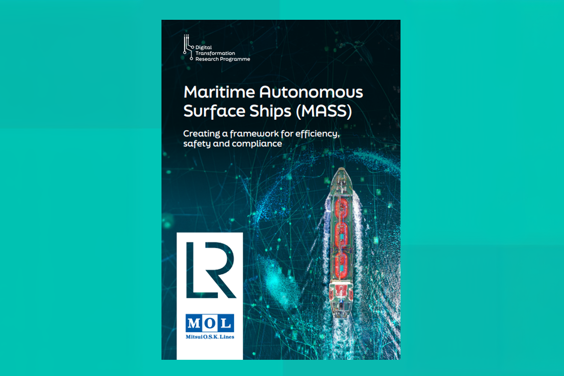
A new collaboration between the Alan Turing Institute, Lloyd’s Register and Lloyd’s Register Foundation aims to advance research which could speed up its adoption, by helping to develop strong and reliable standards which benefit the wider maritime sector.
The project will produce research to develop an open-source systems engineering framework to define the end-to-end development activities relevant to Maritime Autonomous Surface Ships (MASS). The research aims to include perspectives and expertise from across the maritime sector to ensure cover the full lifecycle, including design definition, architecture analysis, modelling, simulations, software engineering, machine learning DevOps, integration, testing and evaluation and sustainment activities.
Developers, manufacturers, and operators require standards that provide assurance that autonomous systems are safe and secure. The emerging IMO MASS code will establish a context for robust application of autonomy in shipping, ensuring the safety of life at sea.
Researchers say there is an urgent need for more detailed guidance, especially for software application and systems engineering processes. Developing clear standards will also help to drive the proliferation of autonomous shipping and accelerate its impact on safety and sustainability, both critical components for ensuring the sector’s longevity.
Specifically, autonomous navigation systems (ANS) have the potential to optimise fuel efficiency through AI-driven navigation and route planning, improve safety through advanced systems for accident prevention and response, and boost supply chain performance through faster port turnarounds.
The researchers will work with developers of MASS and ANS to identify and define their development and collaboration needs, aiming to establish an end-to-end systems engineering framework for ANS.
This project will inform a ShipRight procedure to provide detailed guidance on system design and software principles, ensuring that appropriate processes and checks are in place so that MASS and ANS are safe, reliable, and compliant at every stage.
Dr Chris Nathan, Policy Fellow for the Sustainability Mission at the Alan Turing Institute, said: “The Turing’s strong expertise in AI and policy allows us to provide an architecture for the design of autonomous systems. There’s huge potential for improvements in sustainability, but this depends on the development of strong and robust standards that ensure security and safety. We look forward to working closely with a wide range of experts to co-create these standards with the people who will benefit most.”
Joseph Morelos, Complex and Autonomy Systems Leader, Lloyd’s Register, said: “Lloyd’s Register is committed to developing standards that enable the collaborative development of MASS systems across maritime stakeholders including shipyards, system integrators, equipment manufacturers, software providers and start-up companies. The system engineering standard helps implement the IMO MASS Code, enabling safe, secure and commercially viable deployment of MASS technologies across vessel types.”