


The 84th session of the IMO’s Marine Environment Protection Committee (MEPC84) was always going to tackle the complex decarbonisation of shipping. By its conclusion, MEPC 84 broadly agreed the direction of travel, but the route to get there remains contested.
At the centre of the debate is the IMO’s 2023 greenhouse gas reduction strategy, which commits international shipping to reach net zero emissions by or around 2050. That objective continues to command broad support. Member states reiterated their support for a global solution, recognising that only an IMO-led framework offers the opportunity for unified international regulations.
Political stagnation
But agreement on what form this could take, or when it will arrive, remains elusive. The Net Zero Framework, as approved at MEPC 83 and originally expected to underpin the transition, remains under consideration after adoption stalled in 2025.
However, this is not simply procedural delay and reflects a fundamental divide within the IMO. Some governments support a system built on firm targets, carbon pricing and centrally administered mechanisms. Others favour a more flexible approach, where compliance reflects fuel availability and market readiness. The debate over a mooted global fund, seen by some as a carbon tax, remains a key sticking point.
For shipowners and operators, this uncertainty has practical consequences. Investment decisions on fuels, newbuilds and retrofits will be challenging in the absence of stable, long-term regulatory signals. This could pose a problem if waiting for regulatory clarity makes future compliance more difficult. Despite this uncertainty, much of the industry presses ahead to order more efficient tonnage while adopting or piloting new technologies.


Technical advancement
While political consensus remains elusive, technical development moves steadily ahead. MEPC 84 showed a clear separation between the politics of decarbonisation and how the engineering will work in practice.
Central to the shift towards net zero is the concept of greenhouse gas fuel intensity. All regulatory proposals under discussion revolve around measuring emissions on a lifecycle, or well-to-wake, basis. This has far-reaching implications for fuel strategy as it places equal emphasis the production of fuels as the consumption of those fuels at sea.
For shipowners this introduces a new layer of complexity. Choosing a fuel is about more than onboard performance or cost. The origin of the fuel, the energy used in its production and the wider supply chain all become part of the equation.
Future competitiveness will depend on adopting new fuels while understanding their underlying carbon intensity. Two similar fuels may carry very different lifecycle emissions depending on how they are produced and transported to the ship.
It seems unlikely that the transition to net zero shipping will be driven by a single technology or fuel. Instead, it will be shaped by a combination of efficiency, fuel innovation and data-driven optimisation across the entire energy chain.
Quantifying emissions
Work to advance the IMO’s life cycle assessment framework leaves some key questions unresolved. Methodologies to calculate emissions, the treatment of methane slip, and the challenge of defining representative emission factors across different regions all continue to divide opinion.
The ways in which emissions are measured is also evolving. MEPC 84 adopted new guidelines for monitoring methane and nitrous oxide emissions, including engine load monitoring and continuous emissions monitoring systems, enabling operators to capture emissions data in real time.
This represents a structural shift in the regulation of decarbonisation. The industry appears to be moving towards a model where emissions will be continuously measured, transparently reported and consistently verified. Instead of relying on design standards or fuel specifications, future frameworks will use emissions data based on actual performance.
For operators this would change the conversation. Compliance would be no longer be about meeting a regulatory threshold on paper but showing how a vessel performs day in and day out. That places much greater emphasis on operational efficiency, digital monitoring and onboard systems capable of delivering reliable emissions data.
This approach also shows that reducing fuel consumption remains one of the most effective ways to cut emissions. Efficiency measures, whether through operational optimisation or technologies such as wind assistance, will continue to play a central role alongside the fuel transition.

An industry in transition
The takeaways of MEPC 84 point to an industry in transition, even as the final shape of global regulation continues to evolve. The challenge is how and when different parts of the sector can reach net zero through credible, practical and commercially viable pathways.
For the maritime sector, that means avoiding a one-size-fits-all view of decarbonisation. Bulk carriers, tankers, container ships and specialist vessels will not all follow the same route. Progress will depend on combining efficiency gains, fuel flexibility, lifecycle emissions data and technologies suited to each operating profile.
Regardless of the final regulatory framework, owners and operators that invest early in efficiency, emissions transparency and fuel flexibility are likely to be better positioned for long-term competitiveness.
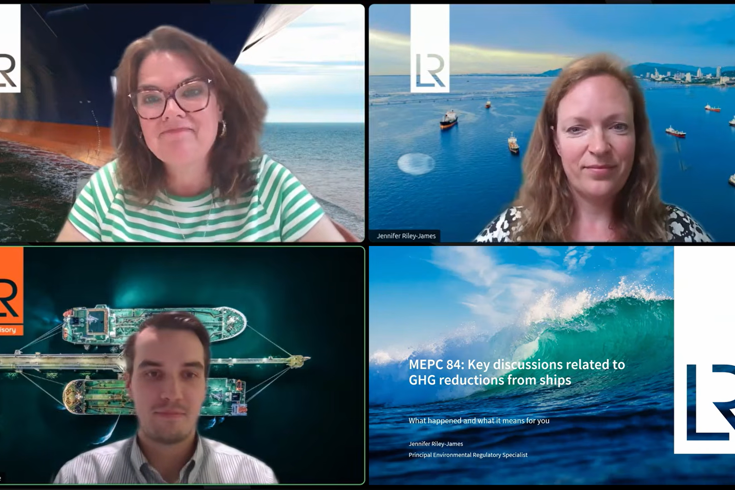
LR's MEPC 84 Webinar: GHG emission measures & their impact on shipping
