


As shipping explores pathways towards net zero, interest in nuclear propulsion continues to grow. Governments, regulators, reactor developers, shipbuilders and shipowners are working together to address the technical, regulatory and commercial issues associated with its future deployment.
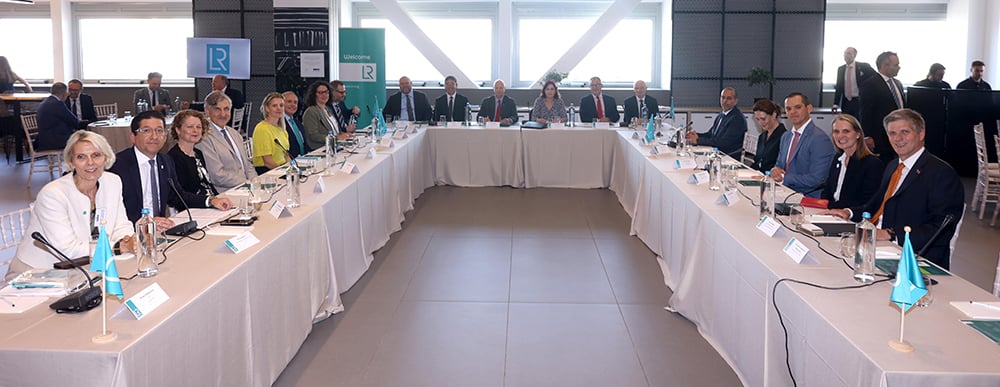
This was reflected at Posidonia 2026, where LR brought senior leaders from across the maritime and nuclear sectors together for a high-level roundtable focused on the practical steps needed to enable safe, commercially viable nuclear-powered shipping.
Creating a framework
The roundtable brought together representatives from shipowners, reactor developers, regulators and industry bodies to explore themes central to the future development of nuclear-powered commercial ships, notably regulation, commercial viability and technical implementation.
Among the strongest themes to emerge was the need for an international regulatory framework that can evolve alongside developments in technology, rather than waiting for mature reactor designs before establishing the rules needed to support deployment.
Opening the discussion, Karine Herviou, Deputy Director General of the International Atomic Energy Agency (IAEA), flagged the importance of regulatory certainty as technologies continue to advance.
"This is a very important conversation," she said. "One of the main issues is the need to have an international framework to provide regulatory predictability."
The discussion also reinforced the importance of collaboration across the maritime and nuclear industries, recognising that progress will depend on regulators, technology developers and operators working together from an early stage.


Reflecting on the event, LR CEO Nick Brown highlighted the pace at which reactor technology is developing
"We heard of the very clear and compelling speed that the regulation needs to be here because we have small modular reactors starting to go critical within the next month."
Since the roundtable, that pace of development has been demonstrated by Deployable Energy, whose Unity demonstration reactor achieved criticality at Idaho National Laboratory in early July. Developed in just two years, the company has also secured orders to supply 500 units a year for data centre applications between 2030 and 2035. LR Advisory has supported the development of the Unity Nuclear Battery and continues to work with Deployable Energy to explore the potential application of advanced microreactors in the maritime sector.
Brown added: "Today's conversation was a very clear indication that the work of Atomic Technologies Licensed for Applications at Sea (ATLAS), the work of the UK Maritime Nuclear Consortium, the work of NEMO, is going to be demanded by industry to ensure that there is a path to application and scale."
Alongside regulation, participants also examined the commercial realities of nuclear-powered ships, including investment models, operating economics and the potential competitive advantages available to early adopters. While significant challenges remain, discussions reflected a growing willingness to explore how nuclear could complement other zero-carbon fuel pathways in the decades ahead.
Central to these discussions is the ATLAS initiative, which aims to establish a clear framework for the safe and secure deployment of civil nuclear technologies in maritime applications by addressing key regulatory, safety and assurance challenges.
Progress is also being made at the International Maritime Organization (IMO). Speaking at the NEMO workshop earlier this month, the IMO announced that it expects a new nuclear code to be adopted in 2032 – four years earlier than previously anticipated, reflecting the growing pace of international regulatory work alongside advances in reactor technology.
Demonstrating technical feasibility
While regulatory frameworks are beginning to take shape, technical development is also accelerating. During Posidonia, LR announced a joint development project with Hyundai Heavy Industries, Korea Shipbuilding & Offshore Engineering (KSOE), Hyundai Glovis, G-Marine Service and the Korea Atomic Energy Research Institute (KAERI) exploring the application of an advanced small modular reactor aboard a pure car and truck carrier (PCTC).
The project examines how a Molten Salt Reactor (MSR) could be integrated into a large vehicle carrier, assessing everything from reactor placement and shielding requirements to vessel stability, propulsion arrangements and cargo capacity.
Safety forms a central part of the work, with LR leading on hazard identification and preliminary risk assessment activities to examine containment, onboard safety systems and operational considerations associated with nuclear propulsion.
The project reached an important milestone with the award of an Approval in Principle (AiP), confirming that the concept is feasible at a preliminary design stage and setting a foundation for further development.
Commenting on the project, Sung-Gu Park, President – North East Asia at LR, said, "While nuclear propulsion is still at an early stage of development, this project shows the importance of building technical understanding now to support future progress.
"Establishing feasibility at concept stage is a valuable step forward, particularly in areas such as cargo optimisation, vessel stability and integrated safety design,” he said.

Concept studies represent an early stage of development and offer a glimpse into future nuclear technologies and how they could be integrated into commercial vessels, helping to identify the engineering, operational and safety considerations that will shape future designs.
The initiatives reflect the breadth of work now underway across regulation, technology development and assurance to support the future of nuclear-powered shipping.
Preparing ports for nuclear shipping
Work is also underway to better understand how ports could support future nuclear-powered vessels.
In June, LR, the Port of Rotterdam Authority, CORE POWER and A.P. Moller - Maersk published a study exploring requirements for nuclear-powered commercial ships to make routine port calls in Rotterdam.
The study considered emergency planning, regulatory responsibilities, port infrastructure and stakeholder coordination, helping to identify the practical considerations associated with routine port calls by nuclear-powered merchant vessels.
Alongside initiatives such as ATLAS and concept vessel studies, the work reflects a broader shift towards considering the wider ecosystem needed to support commercial nuclear shipping, from regulation and vessel assurance through to port operations and infrastructure.
