Many ships carrying global trade today will be operating well into the 2030s, yet the transition to alternative fuels takes time. Of the near-zero emission fuel production capacity estimated to be needed by 2030 only around 4% has reached a final investment decision. Worse, alternative-fuel-capable vessel orders fell from 45% of contracted tonnage in 2024 to 37% in 2025.
This means the global fleet will remain dependent on fossil fuels, or their bio- or e- equivalents, for years to come and must find novel ways to reduce emissions. Energy-efficiency measures reduce fuel consumption, but even those more efficient crossings will continue to produce carbon emissions.
A potential role opens for onboard carbon capture and storage (oCCS). By capturing CO₂ from engine exhausts before it reaches the atmosphere, oCCS could help vessels that cannot yet switch to zero- or near-zero emission fuels drastically reduce their emissions.
From first installations to commercial use
Early commercial installations show oCCS moving beyond concept and pilot-scale development, with amine-based post-combustion capture emerging as the most mature marine option. This is currently the only technology with classed commercial installations, where full-scale systems capture around 30% to 40% of CO₂ emissions. Larger pilots target about 70%.
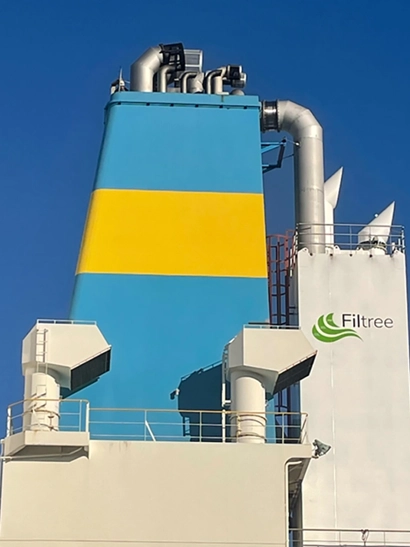
Eastern Pacific Shipping’s Pacific Cobalt became the first classed commercial oCCS installation in 2024 under LR’s Emission Abatement Carbon Capture & Storage (EACCS) (Amine, HFO) class notation, while Solvang’s Clipper Eris is testing a full-scale system designed to capture around 70% of the CO₂ produced by its main engine. These projects add to the growing evidence that oCCS can operate at commercial scale, but its wider value depends on the emissions reductions achieved in practice.
That depends partly on the energy needed to operate the system, which can increase fuel consumption by 15% to 30% in current applications. A 70% gross capture with a 15% fuel penalty would deliver an estimated tank-to-wake CO₂ reduction of around 44%, although waste-heat recovery could reduce that penalty. The resulting emissions reduction, cost and operational impact will vary between ships, making vessel suitability central to the business case.

Finding the right ships
Panos Mitrou, LR Senior Vice President of Shipping Strategy states: “Onboard carbon capture has the potential to become an important part of shipping's decarbonisation toolkit. For the right vessel types and trades, it offers a realistic pathway to reducing CO₂ emissions and managing carbon costs while fuel supply chains, infrastructure and regulations continue to evolve.”
The strongest opportunities for oCCS are likely to be those vessels with sufficient remaining trading life and space for the equipment. The business case will also depend on how and where these vessels operate. For example, medium range and chemical tankers trading on EEA routes have frequent port calls, offering opportunities to offload captured CO₂ while EU carbon-price exposure increases the value of reducing emissions.
For LNG-fuelled vessels and LNG carriers, cold energy released during LNG vaporisation can help liquefy captured CO₂, reducing additional power requirements. Short-sea and feeder vessels could also benefit from predictable routes and regular opportunities to offload. The case for oCCS therefore depends on the technology fitting a vessel’s operating and commercial conditions.
Without these or similar conditions, the case weakens. Ships with limited trading life, little carbon-price exposure or poor access to offloading facilities will be less likely to justify the investment. Access to offloading is another critical factor because onboard storage is limited, setting a limit on how long the system can operate before captured CO₂ must be removed. Voyage length and offloading opportunities therefore directly affect how much CO₂ can ultimately be captured, making where and how a vessel operates as important as what can be installed onboard.
The decisive challenge lies ashore
For oCCS to deliver its intended benefits, captured CO₂ must enter a transport and storage network leading to permanent storage or an eligible use. Limited port reception infrastructure is a constraint, with few ports able to receive ship-captured liquefied CO₂. Many existing facilities are designed for food-grade CO₂ that may not suit exhaust-derived streams. Development is furthest ahead in north-west Europe, supported by emerging North Sea transport and storage networks, but access remains limited elsewhere.
The emissions benefit must also be recognised within relevant regulatory frameworks. The EU ETS can recognise captured CO₂ that reaches qualifying permanent storage or utilisation, while FuelEU Maritime does not yet include oCCS in its greenhouse-gas intensity calculations. The IMO is still developing a global framework covering safety, testing, verification and carbon accounting. Practically, the success of oCCS depends on infrastructure and regulation developing alongside the technology.
Entering an oCCS world
oCCS could offer an emissions-reduction pathway for suitable vessels using fossil fuels or their artificial equivalents as the transition to zero and near-zero emission fuels develops. But there are constraints.
Success depends on matching effective capture technology to ships with enough trading life remaining and suitable trading patterns, to form a strong commercial case. Regular offloading access and supporting transport and storage infrastructure must be developed to connect captured CO₂ to permanent storage or an eligible use. Regulation also needs to recognise the resulting emissions reduction, to help create a working carbon economy.
Where these technical, operational, commercial, infrastructure and regulatory conditions align, oCCS could help bridge the gap between a carbon-intensive present and a carbon-neutral future.
For more information, read the full report Applying Onboard Carbon Capture & Storage to existing ships, which examines where oCCS could work as a retrofit and which ships and trades are best suited to the technology.