


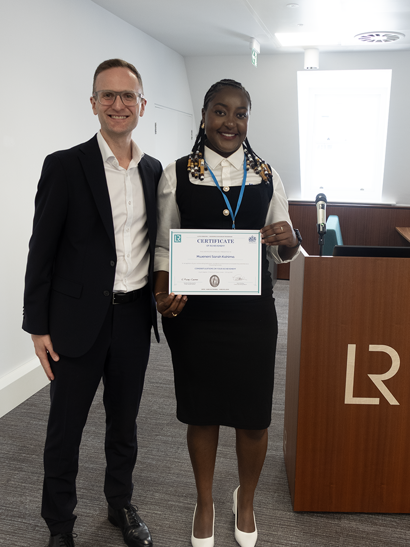
Every year students from around the world take part in the Chevening scholarship programme, offering a year’s study for a master’s degree in the UK to promising future leaders. LR hosted and mentored five students from sub-Saharan Africa in 2026.
LR brought the scholars together to talk about their varied experiences with LR and how those experiences can inform their careers and build their networks. Leaders from LR and the Lloyd’s Register Foundation discussed why investing in talent, diverse perspectives and lifelong learning are all critical to address problems in maritime and society.
Culture crossover
The transition from Africa to Aberdeen can be brutal, but not if it answers your ambitions, as Mweneni Sarah Kahima explains, “Coming from an African country where not everyone can afford to pursue a master’s degree, I was looking to better understand the energy transition, what it really means in practice and what skills are needed. I wanted to learn how it applies to countries like Namibia that are still exploring and developing their oil and gas reserves. What does a realistic energy future look like and how can economic growth balance with decarbonisation?"
Learning is just one factor, however. Chevening also gives scholars access to a network of specialists. “Coming here gave me the opportunity to meet people, build meaningful connections, and engage with energy leaders and professionals already working in the sector, including at LR. Honestly, it has surpassed everything I expected and has been an incredibly rewarding experience,” she enthused.
The energy transition is not the only consideration, as Francisco Abrantes De Castro explains, “Cybersecurity is a challenging and constantly evolving field. I wanted to come and gain knowledge, and to inspire other people and other young scholars like me.
“I knew that I would receive a world-class education in the UK and become involved in a global network of professionals. That was the idea I had before coming here,” he says.
“For me, it has been the opportunity to step into certain rooms that I did not previously have access to,” explains Sodiq Usaefat. “One of the defining moments for me was being invited to an event at St James’s Palace,” as part of a Nigerian diasporan delegation, and met a surprise guest – the King. “I would never have imagined that I would be invited into that kind of setting,” he says.
Despite this distracting presence, this outing had a practical purpose. “I have spent much of my time in the Centre for Infrastructure Materials at Imperial exploring low-carbon solutions for the built environment, thinking about the systems and materials deployed in infrastructure. In our countries, we often find innovative ways to create from what we have with material valorisation and circularity woven into our daily life. In the UK there seems to be an abundance, and material valorisation and circularity thinking may be possible only as part of regulatory compliance or an academic exercise,” he says.
Standards and agility
He noticed that in the UK, institutional standards can be a barrier to progress. “Certification and testing regimes are important, but the processes involved can take years. There may be lessons in how engineers elsewhere adapt existing designs and materials to create solutions that are safe and can benefit society. Research and innovation should not exist purely for the sake of science. Science should address social problems and benefit society,” he believes.
Edson Da Silva Jose Casimiro agrees with this perspective. “The UK has a lot to teach us. One thing I would mention is the sense of urgency. The UK moves fast, and when you live here you understand that, for a country to build a powerful economy, it has to move quickly.
“Another lesson concerns institutional collaboration. We see different government departments cooperating with one another and with the private sector, which we do not see to the same extent in Angola,” she says.
She adds that many developing nations have an advantage of agility. “There are many things with which we can challenge an economy as strong as the UK’s. One is industrial inertia. The UK has many legacy systems, which is good on the one hand, but on the other can make the country more risk-averse when it comes to innovation and technology adoption,” she says.
Cleide Caetano sees the mixed advantages of systems, “You understand why there are policies, and there always seems to be a solution.
“What we can offer the UK is a culture with fewer systems, which gives us greater flexibility. Some activities take longer here because there is a process and a system to follow. But things can be resolved differently in Mozambique. I could simply sit down with a colleague, ask whether we could do something differently and find a solution,” she says, and considers a, “middle ground between circumventing the system and achieving better results from the activities and challenges we face.”
She finished with an observation about the relative opportunities at home and in the UK. “It is difficult to look at two people [in the UK] and tell which one has come from a more privileged background. Everybody appears to have access to opportunities. Someone does not necessarily have to come from a high-earning family to obtain an education or afford the minimum standard of living. That is more challenging in Mozambique and other developing countries,” she says.
Leaders of the future
According to LR’s group chief people officer Gareth Hulley-Carter, businesses need agile staff to deal with the myriad changes brought about by the forces shaping the world, including AI, climate change and ongoing geopolitical uncertainty. "The future will belong not to those who have all the answers, but to those who remain curious, adaptable and willing to keep learning. The best leaders keep asking better questions.”
He advised the scholars to, “See your graduation not as an end point, but as the beginning of your next chapter. Continue seeking new perspectives, investing in your growth and embracing opportunities to learn.”
Tim Slingsby, the Lloyd’s Register Foundation’s director of skills and education agreed, urging scholars not to, “view the end of your scholarship as the end of your relationship with Lloyd's Register."
He said the networks the scholars build today will be critical to their leadership tomorrow, because they will see where improvements can be made, likening this approach to effective safety management. “Those most affected by safety issues must have the greatest say in identifying them and coming up with solutions."
LR’s global technical director, Claudene Sharp-Patel advised the scholars to watch and learn by doing because, “If you don't see it, most of the time you can't imagine it,” and to be seen, as visibility is the key to advancement. “It's not just about having a seat at the table. It's about having a voice,” she said.
In summary, LR’s Business Director and Senior Representative for Africa, Goz Gwam says, “One of the benefits of a programme like this is exposure to different perspectives. Scholars from Africa bring fresh ideas and often highly innovative approaches to problem-solving. In many ways, I see African markets as start-up environments, where normal assumptions do not always apply. People learn to think on their feet and find practical solutions quickly. That resourcefulness, combined with the knowledge and networks gained through Chevening, is incredibly valuable.”
He also highlighted the growing recognition of the blue economy’s importance across Africa. “Countries are developing maritime strategies, blue economy policies and trade initiatives, with governments increasingly recognising the role maritime can play in economic development. There is continued focus on building local capability and retaining value within African economies. Our scholars definitely have an important contribution to make as they apply their learning and experience back home.”