Lloyd’s Register (LR) has teamed up with leading Korean shipbuilding, marine services and nuclear research organisations to advance the development of a nuclear‑assisted car carrier concept.
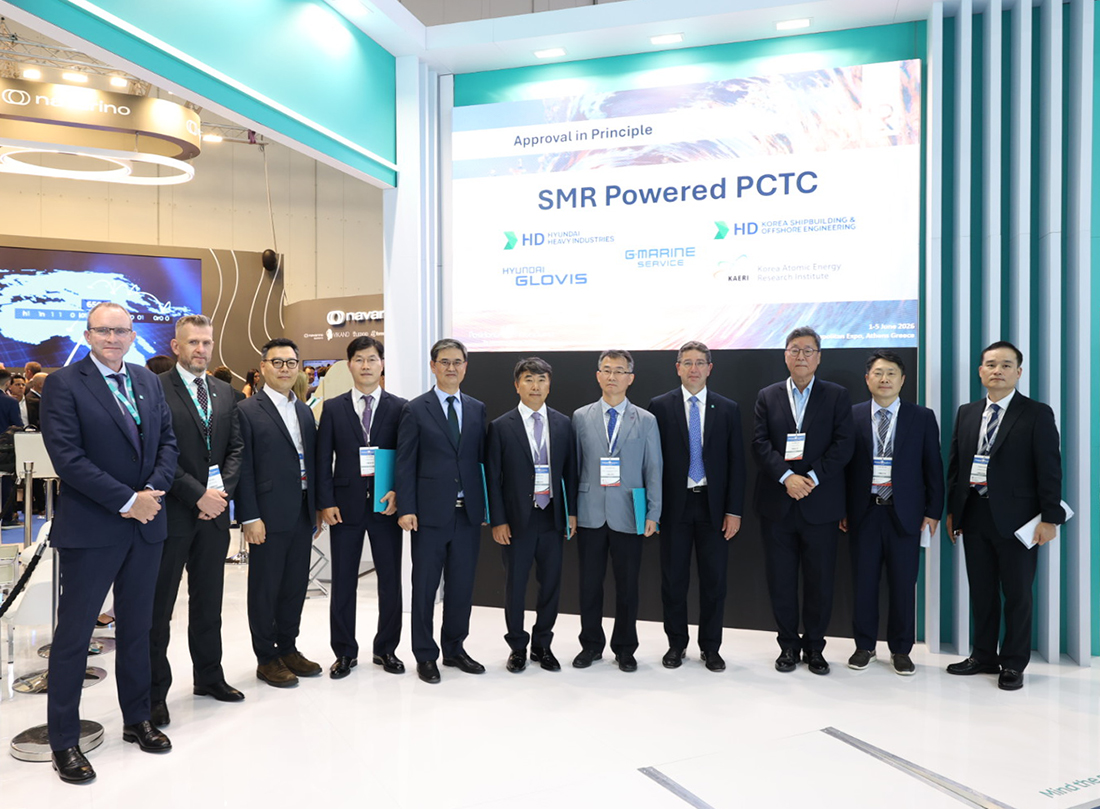
LR is working with Hyundai Heavy Industries, Korea Shipbuilding & Offshore Engineering (KSOE), Hyundai Glovis, G- Marine Service and the Korea Atomic Energy Research Institute (KAERI) on a joint development project (JDP) exploring an advanced small modular reactor (SMR) installation on a pure car and truck carrier (PCTC).
The study focused on how a Molten Salt Reactor (MSR) could be physically and operationally integrated into a large vehicle carrier. Work examined the internal arrangement and segregation of the reactor system, shielding requirements, and the impact on cargo deck layout and vehicle capacity, alongside stability and trim implications linked to the reactor’s weight and positioning.
The partners also assessed propulsion system configuration and power delivery, as well as operational flexibility compared with conventionally fuelled PCTCs, where trade routes and port calls can be tightly constrained.
A key focus of the project has been safety. LR led hazard identification (HAZID) and preliminary risk assessment work, focusing on containment, onboard safety systems and potential operability constraints tied to nuclear technology at sea.
The partners will mark the project milestone with an Approval in Principle (AiP) granting ceremony on 2 June at the LR stand during Posidonia 2026.
Sung-Gu Park, President – North East Asia, Lloyd’s Register, said:
“While nuclear propulsion is still at an early stage of development, this project shows the importance of building technical understanding now to support future progress.
“Establishing feasibility at concept stage is a valuable step forward, particularly in areas such as cargo optimisation, vessel stability and integrated safety design.”
Hong-Ryeul Ryu, CTO and Senior Executive Vice President at HD HHI, said: “With global environmental regulations becoming increasingly stringent and no definitive net-zero fuel yet available, SMR-powered ships can serve as a highly effective alternative, representing a pioneering next-generation maritime technology capable of complying with GHG emission regulations while allowing lifetime operation without refuelling, and HD HHI will remain at the forefront of sustainable maritime technology development.”
A spokesperson from Hyundai Glovis said: “As an operator of one of the world’s largest PCTC fleets, we understand first-hand the operational realities and limitations of conventional propulsion.
“This study has demonstrated the technical feasibility of nuclear-assisted propulsion for large vehicle carriers, while also highlighting broader future potential in vessel design and operational flexibility.
“As a company committed to net-zero by 2045, we believe this represents a credible long-term option worthy of further development together with our partners.”
A G-Marine Service spokesperson said: “The application of small modular reactor technology to a PCTC represents a meaningful step in exploring practical pathways toward zero-emission vessel.
“From a ship management perspective, this project is important not only for assessing technical feasibility, but also for examining how SMR-based propulsion can be integrated into real operating environments, including onboard safety, maintainability, crew support and long-term operational reliability.
“G-Marine Service is pleased to contribute its operational expertise to this joint effort and to support the development of safe and credible solutions for the future of maritime transport.”
A Korea Atomic Energy Research Institute (KAERI) spokesperson, said: “As an institution developing advanced reactor technologies, KAERI considers this work a meaningful achievement in assessing the potential application of SMRs in the maritime sector, taking actual ship operating environments into account. The study is particularly significant because it examined the technical feasibility of applying an MSR type marine SMR to a specific target vessel, namely a PCTC.
“KAERI will continue its efforts, through sustained verification and demonstration, to help ensure that this technology contributes to carbon neutrality in maritime transport.”
At Posidonia 2026, LR reinforced its role at the forefront of maritime nuclear innovation by convening senior leaders from across shipping, nuclear and international regulation for a high-level roundtable on the future of nuclear propulsion.
Held yesterday (1 June) at the Athens Olympic Museum, the closed-door session brought together around 20 senior representatives from shipowners, reactor developers, regulators and industry bodies to examine the technical, regulatory and commercial steps needed to move nuclear-powered shipping closer to reality.
The discussion was designed to move the industry beyond theory and into delivery, highlighting LR’s ability to connect nuclear safety, maritime assurance and cross-sector collaboration in support of safe, commercially viable nuclear propulsion.